Lean Simulation Game for Teams That Drives Change
 Setia
Setia
Spis treści
A delayed order is rarely caused by one person making one bad decision. More often, it is the visible result of too much work in process, unclear handoffs, batching, rework, and teams trying to stay busy instead of moving work. A lean simulation game for teams makes those hidden causes visible in minutes, giving people a safe way to test better decisions before they affect customers, schedules, or margins.
For organizations that want more than a Lean presentation, simulation-based learning changes the conversation. Participants do not simply hear that flow matters. They experience a process under pressure, see performance data shift, and decide together what must change. That experience creates the practical understanding needed to improve real operations.
Why teams need to experience Lean, not just study it
Lean concepts can sound straightforward in a classroom. Reduce waste. Create flow. Use pull. Solve problems at the source. The challenge begins when people must apply those ideas inside a process with competing priorities, uneven workloads, customer expectations, and limited resources.
Lecture-led training can build vocabulary, but vocabulary alone doesn’t change behavior. A team may agree that excess inventory is costly while still producing ahead “just in case.” They may understand that quality matters while still passing defects downstream because stopping feels inconvenient. These are not knowledge failures alone. They are decision-making habits.
A hands-on simulation puts those habits on display without blaming people. Participants work through a modeled process, often in roles that mirror real operational conditions. They manage demand, complete work, respond to defects, measure output, and face the consequences of their process design. When lead time rises, or customer demand is missed, the team has data to discuss rather than opinions to defend.
That distinction matters. Lean becomes a shared operating system, not a collection of tools owned by an improvement specialist.
What a lean simulation game for teams should teach
The best learning experience does not treat Lean as a set of isolated activities. It connects the technical side of improvement to the teamwork required to sustain it. A useful simulation should help participants recognize how a local decision can affect the full value stream.
Flow becomes measurable
Many teams assume high utilization means high performance. In practice, keeping everyone and every machine busy can create queues, longer lead times, and hidden problems. A simulation lets participants compare a traditional push-style process with an improved, flow-based process.
They can see the difference in cycle time, work in process, output, first-pass quality, and customer service. More importantly, they can discuss why the numbers changed. Did smaller batch sizes drive the improvement? Better work sequence? Balanced capacity? Fewer handoffs? The answer is often a combination, which reflects the reality of operational improvement.
Waste is easier to identify in context
The eight wastes are more memorable when people see them happening. Waiting becomes visible when one station is overloaded while another has no useful work. Overproduction becomes visible when finished items accumulate with no customer need. Defects become visible when rework consumes capacity that should support customer demand.
This is where a game beats a poster. Participants can identify motion, transportation, overprocessing, inventory, waiting, defects, overproduction, and underused talent as conditions that weaken performance. They also begin to see waste as a process issue, not a reason to criticize individuals.
Pull systems stop being abstract
Kanban cards and pull signals are easy to describe but harder to appreciate until a team feels the difference. In a simulation, a pull system gives people a practical way to respond to actual demand instead of forecasting every move or pushing work to the next step.
Pull is not a universal answer to every operating condition. Highly variable demand, long supplier lead times, and regulated environments may require thoughtful adaptation. But the principle remains valuable: produce and replenish based on a clear signal, limit work in process, and expose problems early enough to solve them.
Team decision-making gets tested
Improvement work often fails when one department optimizes its own area at the expense of the whole process. A simulation creates a short, focused setting where cross-functional participants must make decisions together. Operations, quality, supply chain, customer service, and leadership can see how their choices interact.
The goal is not to “win” the activity by moving pieces faster. The goal is to build the habit of asking better questions: What does the customer need? Where is work waiting? What problem is preventing flow? What evidence supports this change? Who needs to be involved before we standardize it?
The learning cycle that turns activity into capability
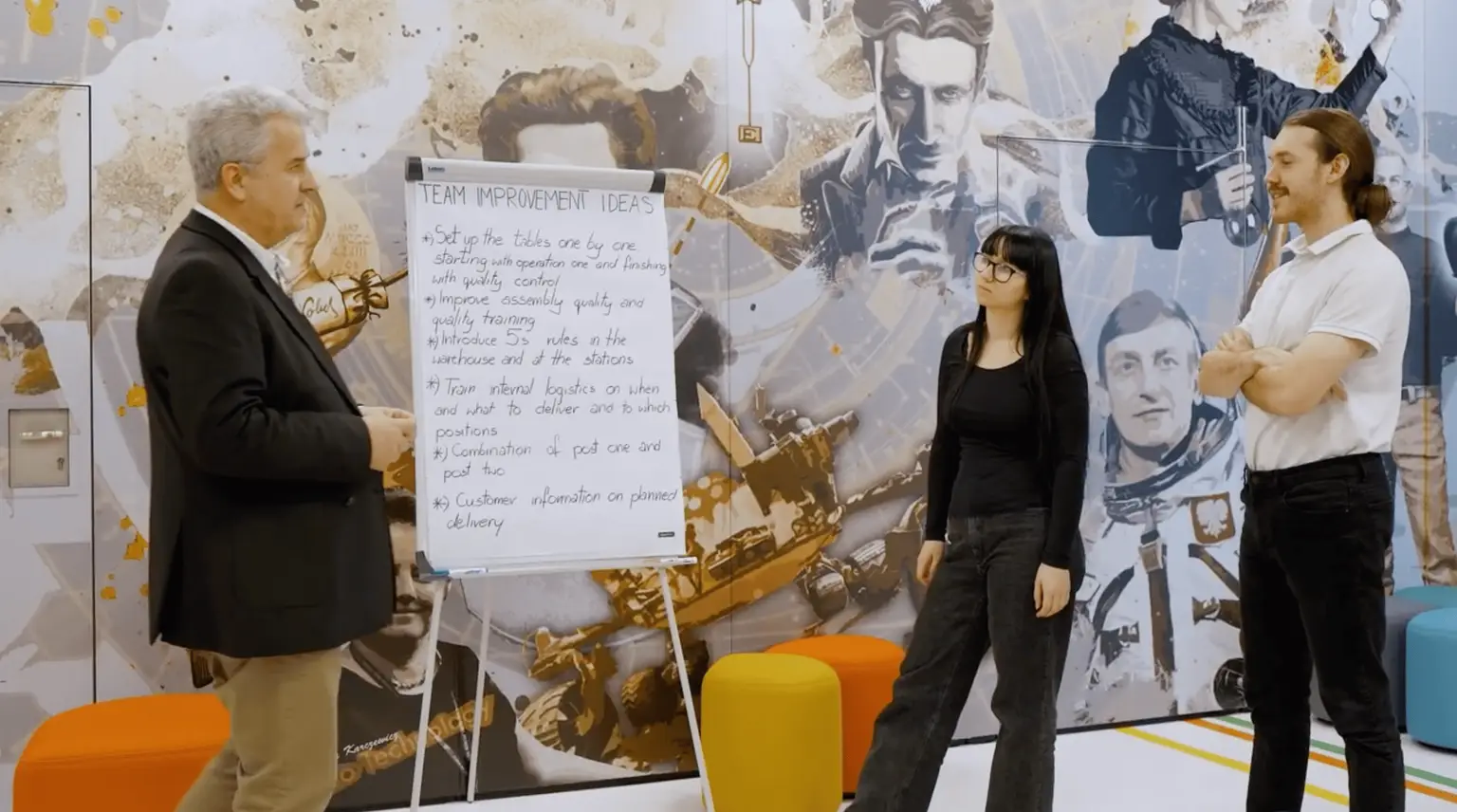
A simulation has value because it compresses learning. But playing the game alone is not enough. The debrief is where participants translate an experience into a repeatable approach for their own work.
An effective session follows a practical cycle: learn by playing, learn by understanding, then apply in the real world. First, participants experience the current-state process and its constraints. Next, they review performance results and connect those results to Lean principles. Finally, they identify a workplace process to test the same thinking.
The facilitator plays a central role. They should not hand the team a predetermined answer too early. Instead, they guide participants to examine the data, challenge assumptions, and distinguish a genuine root cause from a quick workaround. This is especially important when experienced leaders attend. Seniority can speed decisions, but it can also silence frontline insight if the session is not designed for shared problem-solving.
A strong debrief should address more than output. Ask what created delays, how defects traveled, what work added customer value, and which changes reduced risk. Discuss what the team would standardize and what should be tested further. That final question matters because Lean is disciplined experimentation, not a one-time event.
How to use simulation training across your organization
The right format depends on your goals, participant experience, and the process challenges you are trying to address. A new team may need a foundational introduction to value, flow, pull, and waste. A mature continuous improvement group may benefit more from advanced facilitation, data interpretation, structured problem-solving, and implementation planning.
For leadership teams, a simulation can create alignment around the conditions required for improvement. Leaders see why teams need time to solve problems, why visual management matters, and why measuring only short-term output can create damaging behaviors.
For frontline and cross-functional teams, the experience can build confidence. People who may not identify as Lean practitioners can still recognize a bottleneck, test a countermeasure, and contribute an idea that improves the process. That inclusion is essential. People closest to the work often see waste first.
For internal trainers and HR or learning teams, a reusable simulation provides a more engaging alternative to passive training. It can support onboarding, supervisor development, continuous improvement events, Lean certification pathways, and team-building workshops. The investment is strongest when the organization plans to repeat the learning, coach application, and track results after the session.
Sabat Consulting’s GET LEAN simulation game is designed around this practical model, helping participants connect hands-on decisions, Lean theory, performance data, and workplace application in one learning experience.
Measure what happens after the workshop
A successful workshop can generate energy, but energy is not the same as improvement. Before running a simulation, define what practical follow-through should look like. That may be a current-state map, a pilot pull system, a daily problem-solving routine, a 5S improvement, or a reduction in a specific source of rework.
Choose a small number of measures that reflect the problem. Depending on the process, these may include lead time, on-time delivery, first-pass yield, work in process, backlog age, labor hours per unit, or employee suggestions implemented. Avoid measuring everything. A crowded scorecard can hide whether the team’s countermeasure actually worked.
Then establish ownership. Participants should leave with a clear next experiment, a responsible owner, a review date, and a way to share what they learn. Not every improvement will produce the expected result. That is not failure if the team uses the outcome to refine its understanding and take the next informed step.
Choose a game that respects real work
Not every activity labeled “interactive” produces operational learning. A worthwhile Lean simulation should be engaging, but it should also be credible enough for experienced managers and accessible enough for people new to Lean. It needs clear measures, realistic trade-offs, room for participants to make decisions, and a structured debrief that connects the exercise to work.
The strongest outcome is not that participants remember a fun workshop. It is that, when the next delay, defect, or handoff problem appears, they have a common language and the confidence to improve it together.